
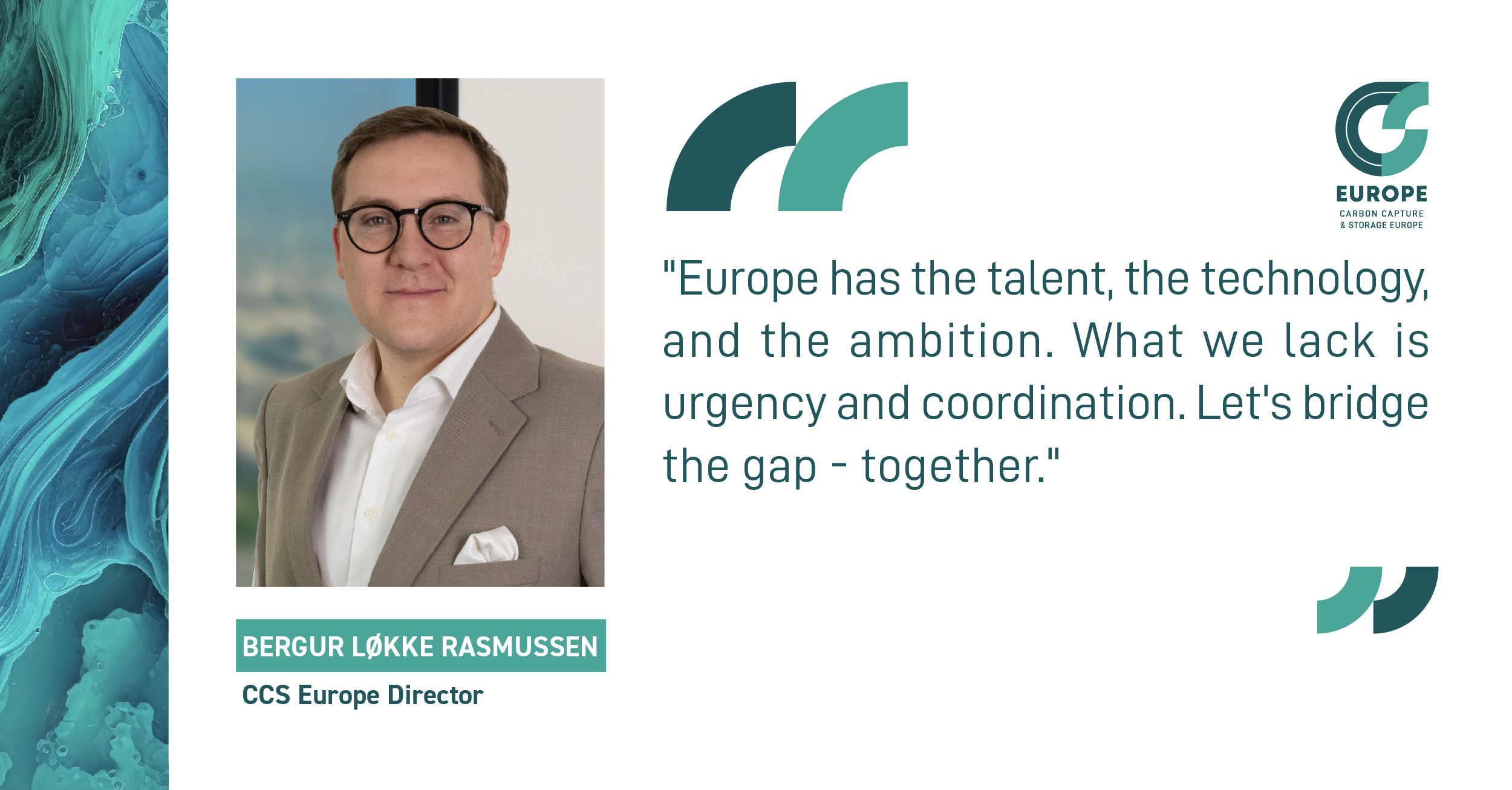
On 15 October, Director of CCS Europe, Bergur Løkke Rasmussen, gave a keynote speech at the 2025 CarbonZero Global Conference & Exhibition in Bucharest, Romania.
In his speech, Bergur highlighted that CCS is essential for achieving the EU’s net-zero ambitions, particularly for hard-to-abate industries like cement, lime, and chemicals. He warned, however, that the gap between ambition and deployment remains vast, with Europe capturing less than one million tonnes of CO₂ today compared to the 280 million tonnes needed annually by 2040.
Bergur called for urgent political coordination, investment, and clear regulatory frameworks to scale up CCS infrastructure across Europe, thus turning commitments into real climate action.
You can find Bergur's speech in its entirety below
Bridging the Gap: Accelerating Carbon Capture Deployment for Net-Zero
Good afternoon,
It’s a pleasure to be here in Bucharest, a city that reflects both Europe’s industrial legacy and its future potential. I’m Bergur Løkke Rasmussen, Director of CCS Europe — an advocacy campaign supported by environmental NGOs, including Bellona, as well as industry — and I’m here to speak about how we can bridge the gap between ambition and action in deploying carbon capture and storage, or CCS, across Europe.
Let me begin with a reality check.
The European Commission has made it clear: extensive deployment of carbon capture technologies is indispensable to achieving net-zero emissions.
Climate modelling shows that by 2040, Europe must capture and store 280 million tonnes of CO₂ annually from industrial sources. Yet today, less than one million tonnes are being captured. The gap between aspiration and reality is vast — and growing.
In 2009, the EU adopted the CCS Storage Directive — a legal framework meant to enable the safe geological storage of CO₂. It was a landmark moment. But since then, progress has been minimal.
For over a decade, the Directive remained largely underused. Only this summer did Europe see its first commercial-scale CO₂ injection — through the Northern Lights project in Norway. It’s a major milestone, and we should celebrate it. But it also highlights how far we still have to go.
To meet the EU’s own targets — including 50 million tonnes of annual storage capacity by 2030 under the Net-Zero Industry Act — we will need dozens more projects like Northern Lights. And we need them fast.
In 2021, the EU made a historic commitment: to become climate-neutral by 2050. The task is clear. Now, we need to deliver.
This lack of progress — combined with the urgency to decarbonise hard-to-abate sectors like cement, lime, and chemicals — is precisely why CCS Europe was founded.
We saw that the absence of a coherent framework made investment nearly impossible. And we understood that to create such a framework, we needed a supportive political context — one that moves beyond the outdated perception of CCS as a tool to prolong fossil fuels, and instead focuses on the sectors where CCS is indispensable to reach net-zero.
In recent years, we’ve seen a renewed political push for CCS.
The European Commission has started actively working on industrial carbon management. We welcome this. But we also know that industry cannot wait.
The Net-Zero Industry Act now obliges oil and gas producers to develop 50 million tonnes of CO₂ storage capacity annually by 2030. The Clean Industrial State Aid Framework (CISAF) allows Member States to support CCS more easily. And later this year, we expect the Industrial Decarbonisation Accelerator Act to propose lead markets for low-carbon industrial products.
These are important signals. But they must be followed by concrete frameworks, infrastructure planning, and funding mechanisms.
And they must be coordinated — not just at EU level, but across Member States.
Because here’s the truth: without national strategies, CCS will not scale.
Countries like Denmark and the Netherlands are showing leadership. But most Member States still lack a clear roadmap. We need political will at all levels — from Brussels to national capitals — to make CCS deployment a reality.
Last year, the European Commission published the Draghi Report on European Competitiveness, analysing how Europe can remain competitive in a rapidly changing, decarbonising, and increasingly fragmented global economy.
Its message regarding CCS was clear:
- CCS is a key solution for decarbonising energy-intensive industries, removing CO₂ from the atmosphere through biogenic sources, and using captured CO₂ as a substitute for fossil fuels.
- But massive investments and accelerated regulatory support are needed to fast-track deployment.
This is not just a policy suggestion — it’s a recognition that CCS is indispensable for Europe’s industrial future.
I also want to briefly acknowledge Chris Davies, my predecessor at CCS Europe. He was the European Parliament’s rapporteur for the CCS Directive in 2009 – and unfortunately, still the only one to date.
His work laid the legal foundation we still rely on. But as we’ve seen, a directive alone is not enough — we need political will, a comprehensive and enabling regulatory framework, infrastructure, and investment.
And we need industry to raise its voice — to make clear to policymakers that CCS is not a luxury, but a necessity.
Let’s talk about cement, lime, and chemicals. These sectors face process emissions that cannot be eliminated by switching to renewables.
For them, CCS is not a choice — it’s the only viable path to net-zero.
And here’s the truth we must acknowledge:
For emitters under the European Emissions Trading System (ETS), CCS is not a business case — it’s waste management.
These industries are legally obliged to reduce emissions. They don’t profit from capturing CO₂ — they comply. And as free allowances phase out, they will bear the full cost of emissions.
We must stop pretending otherwise. The policy framework must reflect this reality.
Even when industries are ready to capture CO₂, they often face a dead end. Why?
Because the transport and storage infrastructure is missing.
The EU’s CO₂ transport network, as envisioned in the Industrial Carbon Management Strategy, could reach 19,000 km by 2050, requiring up to €23 billion in investment.
But planning is fragmented. Permitting is slow. And coordination is lacking.
We know that the European Commission has started working on an EU framework for the CO₂ market and legislation. We expect it in Q3 next year.
We need the European Commission to:
- Accelerate permitting for capture, transport, and storage
- Coordinate infrastructure planning across borders
- Ensure ETS revenues are used to build this backbone
So yes, the European Commission has started to bridge the gap by working on regulatory and financial frameworks.
But what we see in Brussels too often is this: we risk ending up with pieces of a puzzle that don’t fit together.
That’s why CCS Europe is calling for a cohesive vision of how Europe’s future carbon economy will look.
We need long-term clarity both on EU and national levels to enable successful infrastructure planning, guide investment, and align industrial strategy.
Based on the Commission’s own modelling, Europe will need to capture and store at least 280 million tonnes of CO₂ annually by 2040 to meet a 90% greenhouse gas reduction target.
This is the scale we must prepare for. And it must guide every decision we make today.
2040 is only 15 years away — one or two investment cycles at best.
And there is much work to be done before then. Concretely, we will need:
- A clear and predictable price signal from the ETS
- Lead markets for low-carbon products
- De-risking and funding support
- A clear and fair regulatory framework for CO₂ transport and storage
- A business case for carbon removals
- EU-level coordination for transport and storage network planning
- A strong knowledge-sharing platform for permitting authorities and project developers alike
These are critical steps. But they must be fast-tracked — and coordinated.
Europe has the talent, the technology, and the ambition. What we lack is urgency and coordination.
Let’s build the infrastructure.
Let’s fund the deployment.
Let’s ensure that no emitter is left without a path to decarbonise.
The Draghi Report gave us the diagnosis.
The strategy is forming.
Now it’s time to act – at EU level and in every Member State.
Let’s bridge the gap — together.
Thank you.